The Legg House: A Victorian Survivor on Park Avenue in Minneapolis
Once home to a diamond merchant, a neighborhood doctor, and even tied to a national FBI case, the Legg House remains one of Minneapolis’ last colorful Victorian survivors.
August 15, 2025 (Updated: August 15, 2025)
The Legg House: The Colorful Victorian Home on Park Avenue in Minneapolis
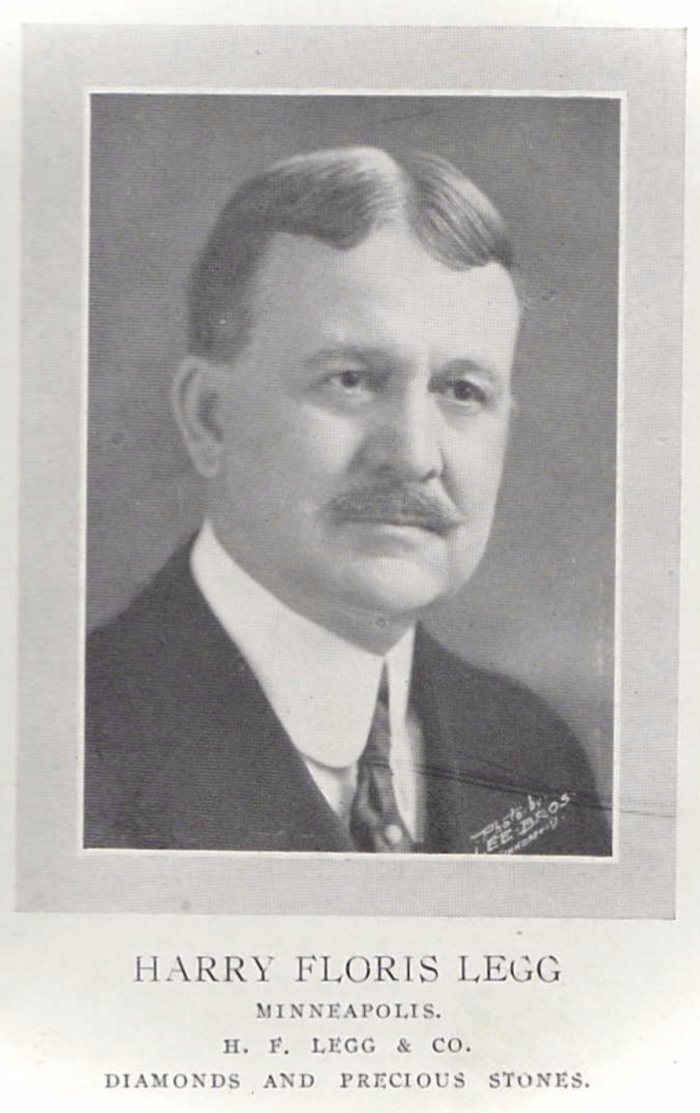
If you’ve driven down Park Avenue in Minneapolis, you might have noticed a brightly painted Victorian house nestled between modern commercial and apartment buildings. That’s the Legg House—built in 1887 and named for its original owner, Harry F. Legg. The Legg family only lived there for nine years, but the home’s history since then is full of colorful, sometimes dramatic, stories.
The Legg Family Moves In
Harry F. Legg moved to Minneapolis in 1865 when he was just ten years old. By adulthood, he had become a successful diamond merchant and a charter member of elite Minneapolis clubs, including the Minikahda Club, which still operates today. With his success in business, Legg could afford to build the gracious home. In 1896, Harry and his family left 1601 Park Avenue for the fashionable Lake of the Isles neighborhood.
One reason for the move may have been the city’s rapid growth. Park Avenue was originally a quiet, prestigious area on the edge of Minneapolis, with easy access to downtown. But in 1891, the Legg House and several neighboring homes were burglarized. While the Leggs were away, thieves stole about $1,000 in valuables—equivalent to roughly $36,000 today.
In 1895, the younger Harry—nicknamed “Little Harry Legg”—was knocked down by a cyclist. A school reporter, likely a classmate at Madison School, wrote that he was “bleeding freely” but not seriously hurt. He later became Harry G. Legg, a nationally known golfer.

Minneapolis Journal August 24, 1895
Dr. H. E. Cary and Family
By 1904, the house had new owners: Dr. Herbert Cary, his wife, and their daughter Jeannette. Dr. Cary operated his private medical practice from the home until retiring in 1919. One notable event came in 1905 when his father was bitten by a dog while administering medicine. Though the wound was minor, Dr. Cary insisted the dog be tested for rabies—and it came back positive. Thanks to his quick action, his father lived for another five years.
New Life as a Rooming House
By the 1920s, Park Avenue had been fully absorbed into the growing city. The Legg House became a rooming house with a rotating list of tenants. In 1926, one resident sought carpool partners for a trip to Yellowstone and the Black Hills; in 1939, another won a special prize in a cooking contest.

Minneapolis Star Tribune May 5, 1926
During the 1950s and ’60s, one of the more permanent families in the home was Edwin A. Rath and his wife Verna. The couple raised their large family here, and in 1963 their eight-month-old daughter Mona Lee was photographed by the Minneapolis Star-Tribune receiving a dose of the new oral polio vaccine. Her happy reaction helped promote the vaccine’s ease and safety.
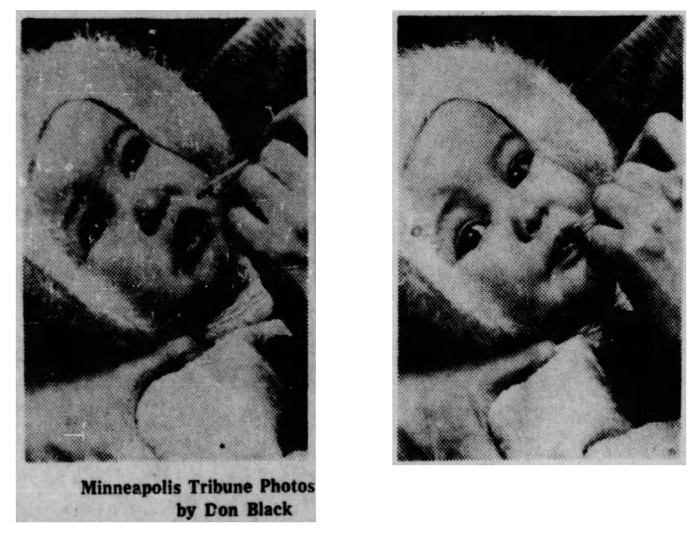
Minneapolis Star Tribune February 11, 1963
By the 1970s, the Victorian home was being marketed as an income property, apartment building, or even a potential men’s club. With its commercial and industrial zoning, it was at risk of being demolished for redevelopment.
Restoration Begins
That changed in 1976 when John and Pat Vetrano bought the house with plans to restore it to its original glory. They removed layers of linoleum, reopened bricked-up fireplaces, and succeeded in getting the Legg House listed on the National Register of Historic Places. They also ran a Victorian antique resale and reproduction furniture business out of the home.
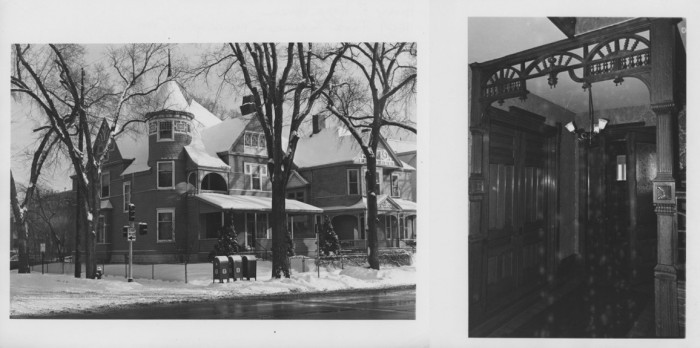
Images from the 1976 National Register of Historic Places Nomination Form
Scandal!
But in 1990, the Legg House’s story took a dramatic turn. The FBI uncovered a $20 million cache of rare stolen books at the Iowa home of notorious collector Steven Blumberg. As investigators dug deeper into Blumberg’s activities, they traced another stash—this time of stained glass and antiques—to 1601 Park Avenue in Minneapolis.
An FBI raid on the Legg House in 1990 revealed around 50 stained-glass windows and other valuable items, believed to have been taken during burglaries of local residences. John Vetrano was linked to the stolen-property ring in Minneapolis. Convicted of receiving stolen goods, this downfall brought the Vetranos’ time in the historic Park Avenue home to an abrupt end.
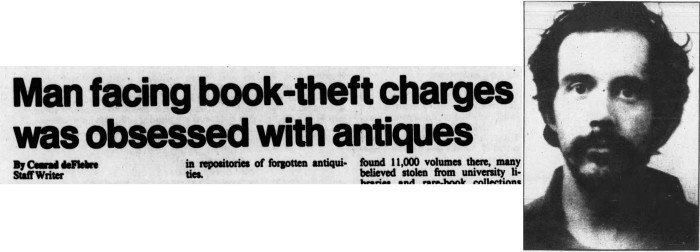
Minneapolis Star Tribune March 22, 1990
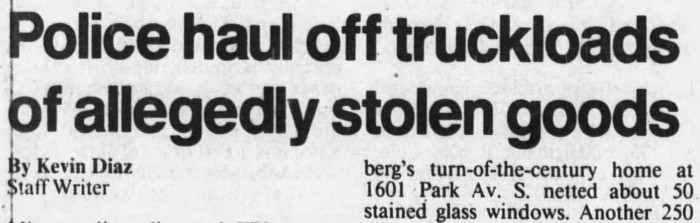
Minneapolis Star Tribune April 5, 1990

Minneapolis Star Tribune August 17, 1990
What's Next?
The Legg House has welcomed generations of Minnesotans, each adding their own chapter to its story. In recent years, it has been lovingly restored as a grand single-family home, even hosting guests as an AirBnB and event space. Its most recent owner adored the house, but now the time has come for someone new to step in.
For the right dreamer, this isn’t just a house—it’s a living piece of Minneapolis history. The soaring Victorian architecture, the colorful details, and the rich legacy of everyone who has called it home all combine into something rare and magical. Nestled on Park Avenue for nearly 140 years, the Legg House stands ready for its next caretaker, someone who will fall in love with its beauty and continue the story into the future.
Not the Up House—But Even Better: Edith Macefield Said No to $1 Million, So They Built a Mall Around Her
You may have heard about the one-bedroom house in Seattle that blocked a mall.

Beyond Thrilling Experience of Buying a Historic Property
You might have always fancied living in an 18th-century property with Georgian architecture, or a 19th-century exotic mansion.

The Biltmore Estate: The Story Behind America’s Largest Home
How America’s largest home came to life, from its Gilded Age origins to the people and stories that shaped it
How to Renovate Abandoned Properties
During your life you have probably come across one or two abandoned properties you have considered buying or selling.
