Share what you know,
and discover more.
Share what you know,
and discover more.


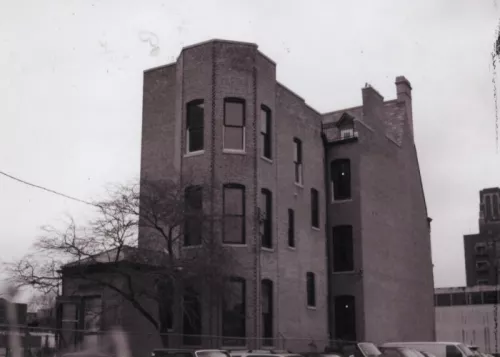
First Regiment Infantry Armory, 1552 South Michigan Ave Chicago, Cook County, IL
Designed by the firm of Burnham and Root in 1890, the Armory is an impressive, though rather curious work from their oeuvre. According to contemporary accounts, the building was designed to serve as a true medieval-type fortification, with a heavily protected arched door, firing slits, and battlements. In addition, interior provisions were made for the training and accommodation of the regiment, as well as for its social functions. The ornamental stone and brick mass of the exterior could indeed withstand a siege, if only symbolically. The severe cubic form with battered masonry walls and a great central arch recall the earlier, more sophisticated designs of H. H. Richardson.
First Regiment Infantry Armory, 1552 South Michigan Ave Chicago, Cook County, IL
Designed by the firm of Burnham and Root in 1890, the Armory is an impressive, though rather curious work from their oeuvre. According to contemporary accounts, the building was designed to serve as a true medieval-type fortification, with a heavily protected arched door, firing slits, and battlements. In addition, interior provisions were made for the training and accommodation of the regiment, as well as for its social functions. The ornamental stone and brick mass of the exterior could indeed withstand a siege, if only symbolically. The severe cubic form with battered masonry walls and a great central arch recall the earlier, more sophisticated designs of H. H. Richardson.

Posted Date
Sep 27, 2021
Source Name
Library of Congress