1709 Broderick Street: The Real Full House Home in San Francisco
Step inside the history of 1709 Broderick Street, the real Full House home in San Francisco. From its 1883 Victorian beginnings to TV fame, this house has stories to tell.
August 13, 2025 (Updated: August 13, 2025)
1709 Broderick Street: The Real Full House Home in San Francisco
Does this home look familiar? If you’re a fan of the TV sitcom Full House, it probably does. The facade of 1709 Broderick Street in San Francisco was used as the Tanner family’s home, appearing in the show’s iconic opening credits.
A Victorian House Chosen for TV Fame
Built in 1883, this Victorian home in Lower Pacific Heights was chosen to represent the Tanner residence because producer Jeff Franklin wanted a quintessential San Francisco Victorian—and this one stood out. While most of the show was filmed on the Warner Bros. Studio lot in Los Angeles, the Full House house San Francisco exterior became one of the most recognizable homes on television.
On the show, the residents were Danny Tanner, his daughters D.J., Stephanie, and Michelle, along with Uncle Jesse and Danny’s friend Joey. Recently widowed, Danny relied on his brother-in-law and best friend to help raise his kids. Full House ran on ABC from 1987 to 1995, airing 192 episodes, before being revived as Fuller House by Netflix from 2016 to 2020.
Although not a critical darling, the show was a huge success with audiences and remains a nostalgic favorite. With that success, the house itself became a San Francisco landmark. In 2016, Franklin bought the real home for $4.1 million. Under his ownership, it was upgraded for earthquake safety and partially restored to match its sitcom appearance. Fans visiting San Francisco often stopped to snap photos, sometimes in such large numbers that neighbors grew frustrated. Eventually, the city restricted tour buses—vehicles carrying more than eight passengers—to cut down on the crowds.
Real Families of 1709 Broderick Street
While the Tanners were fictional, the house has seen many real families over the years. When 1709 Broderick Street was first built in 1883 by Charles Lewis Landry, politician Thomas O’Brien and his family became early residents.
O’Brien served as San Francisco’s tax collector from 1888 to 1892. In 1896, he made a run for Congress but lost, though he remained a respected figure in San Francisco politics. In 1900, while giving a speech on the steps of the U.S. Mint in San Francisco, he was arrested—a move later ruled unlawful. He sued for false imprisonment and won $25,000 in damages, a record sum for such a judgment at the time.
Although a lifelong Republican, O’Brien was known for crossing political lines. In 1904, he attended the Democratic National Convention, caught up in the excitement surrounding San Francisco newspaper magnate William Randolph Hearst’s presidential campaign. A reporter once summed up his approach by writing, “Though he is a Republican, Tom O’Brien never overlooks an opportunity to take a hand in politics!”
O’Brien passed away in 1905, quietly fading from political memory. But his career remains a small piece of San Francisco’s rich political history, linking the city to national events at the turn of the century.
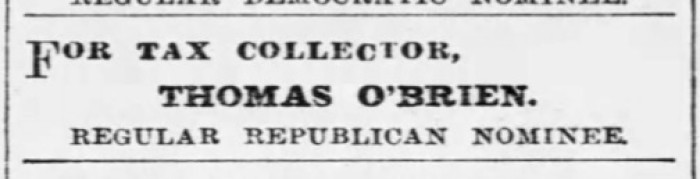
The San Francisco Examiner October 28, 1888
In 1920, the Boegershausen family moved into 1709 Broderick Street. John Boegershausen had arrived in San Francisco in 1898 and opened a hardware and kitchenware store with his brother. After the 1906 earthquake, their business shifted to sheet-metal work, a service in high demand at the time. Between 1906 and 1940, their company was credited with constructing nearly every church steeple in San Francisco. Thanks to this success, John, his wife Ernestine, and six of their seven children were able to move into the house, just blocks from the family business.
Sadly, John passed away only a few years after moving in, but Ernestine and the children remained in the home for decades. Newspaper clippings of the time show the children’s marriage license applications, a reminder of how the house remained central to the family’s life. When Ernestine passed away in 1939, she was one of the last Boegershausens to live there.
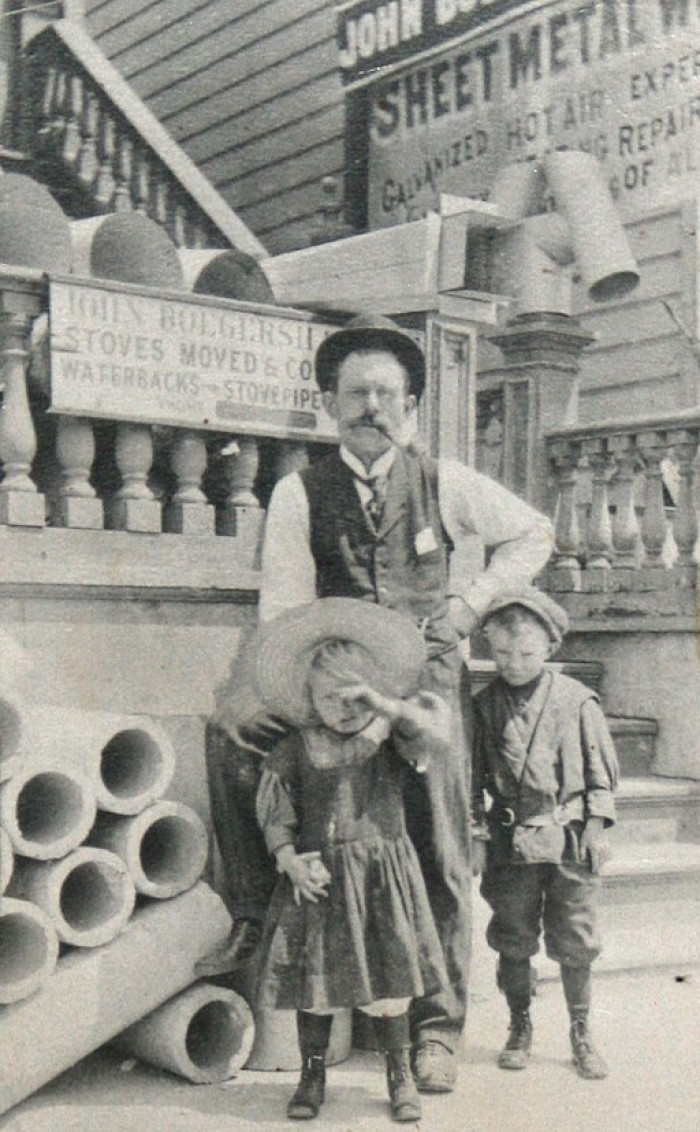
John Boegershausen in front of his store
A memorable story from 1926 reveals that John Boegershausen’s son, also named John, grew tired of being nicknamed “John Bughouse” while running Boegershausen Hardware. He went to court and successfully changed his last name to Berger.
Changing Hands Over the Years
Throughout the 1950s and 1960s, 1709 Broderick Street was frequently listed for sale or rent. In 1955, the asking price was $14,500; by 1969, it had risen to $42,000. A 1970 ad listed it at $39,500, and by 1972 it was on the market again, described as a “row Victorian, 1883, artistically remodeled, 3 bedrooms, delightful formal garden, garage” with a price tag of $55,000.
By 1990, the property was back on the market—this time, the neighborhood of Lower Pacific Heights was much more desirable. The asking price had jumped to $725,000, likely boosted by its newfound fame as the Full House exterior filming location. By 2016, the price soared to $4.1 million, when Franklin purchased it. In 2025, it changed hands again, selling for $6 million.
A House That Keeps Making History
From Victorian-era politics and church steeple builders to sitcom stardom and skyrocketing real estate values, 1709 Broderick Street has been home to a wide variety of stories. Whether remembered as the real Full House house in San Francisco or as a piece of local history, this Victorian continues to capture imaginations—and its story is far from over.
The Freshest House in Los Angeles: Step Inside The Fresh Prince of Bel-Air Home!
Have you ever wanted to see what’s inside the real Fresh Prince of Bel-Air house? With our timeline, now you can! Join us as we look at the freshest house in Los Angeles and explore its fascinating history.
The Biltmore Estate: The Story Behind America’s Largest Home
How America’s largest home came to life, from its Gilded Age origins to the people and stories that shaped it
House genealogy 101: Discovering home history through census records and property addresses
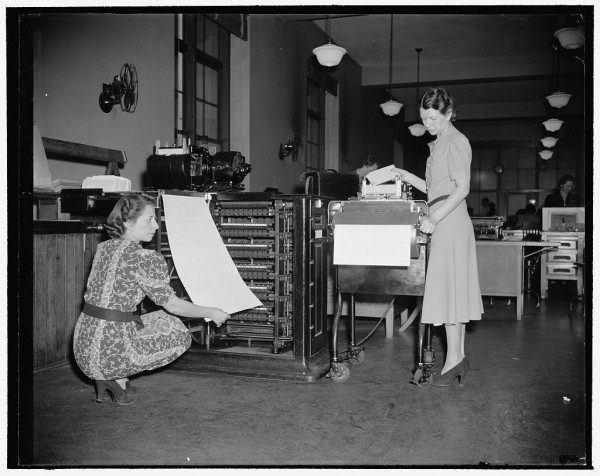
Utilizing census records and property addresses to learn more about your home's history.
In with the Renovations, Out with the Tear Downs
Let’s talk about the power of home renovations and interior design staging.
