Edgar Allan Poe's House of Literature: Small but Sturdy
Edgar Allan Poe claimed that his home was in Richmond, Virginia, but before Richmond he lived in Baltimore, Maryland, in this small unassuming home. What happened to it after Poe and who lived there?
September 12, 2025
Many of you may already know Edgar Allan Poe. An author, poet, and a man who died a mysterious death. All of these define the man who's made his mark on American literature. But behind the curtain of fame lies a man who was obsessed with horror and lived his life on the edge of death. To understand Edgar Allan Poe, we look to the places in which he lived, whether it be in Philadelphia, Baltimore, or Virginia.
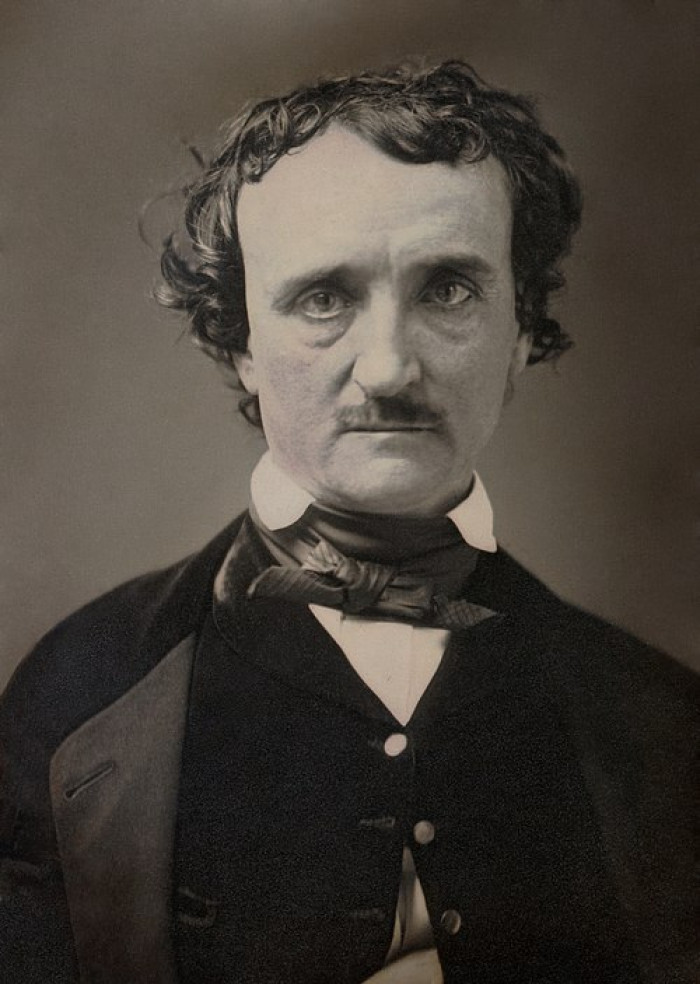
Edgar Allan Poe, c. 1849
Today, we will be examining a house located at 203 N Amity St. in Baltimore, Maryland. The house, numbered as 3 Amity St. in Poe's time, was the place where the young Poe lived for a couple of years.
Built around 1830, the home was rented by Poe's aunt, Maria Clemm. She lived there with her mother, Elizabeth Cairnes Poe, and her daughter, Virginia, who would later become Poe's wife.
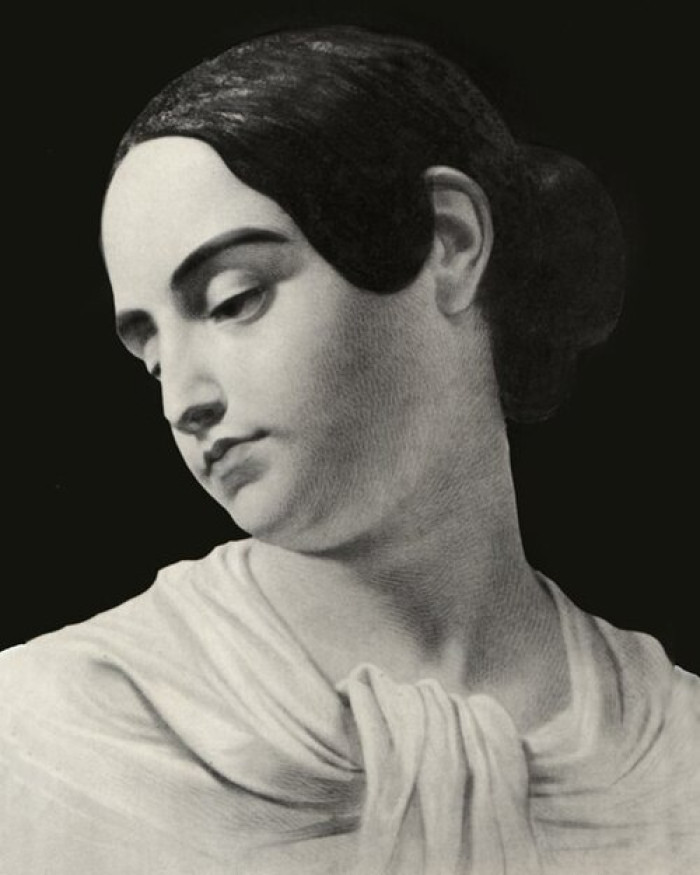
Virginia Clemm Poe, painted after her death
The brick house rested amid the Poppleton neighborhood of Baltimore. It consisted of 2 ½ floors and was not very large, though since Poe's family was small, it may have been a decent fit for its residents. We do not have census records from this time, but we do know that Poe lived in this house from around 1833 to 1835, when he moved to Richmond, Virginia, to further his writing career.
After Poe leaves the home in 1835, we lose track of what was happening at the house at 203 N Amity St. His aunt rented the house, so for the years after Poe's family lived there, it may be that the house continued to be rented.
The first documentation that we do have is the 1880 census. In it, widow Mary Krouser is listed as the occupant along with the Martin family. The Martins, consisting of John, Emma, and their son John, could have rented out the house, considering that Mary Krouser and the Martins are listed as having the same address.
In the 1900 census, the occupants changed once again. Henry Jones, his wife Lizzie, and their son Washington lived in the house. Henry worked as a day laborer, and Lizzie worked as a laundress. With them are boarders, Lucy and Julia Boyd, who worked as a servant and a cook, respectively.
The Joneses and the Boyds must have moved out of the home by 1906, when our next document appears. To understand our next piece, the enlistment papers of James Knox Jr., we must go forward to the 1910 census.
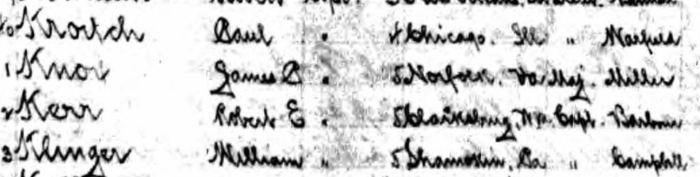
James Knox Jr.'s Enlistment, c. 1906
This census listed James Knox, his wife Mary, and their daughter, Ethel, as the occupants. What should be noted here is that James Knox Jr. is not listed. He had run away from home before the family moved to Baltimore and had enlisted in the military. He will not be seen by his family until the late 1920s. For now, the rest of the Knoxes lived at the home; James Knox worked as a watchman at a bank, and his daughter Ethel worked as a laundress at a hospital.
By 1920, the Knox family still lived in the house. James Knox still worked as a watchman at a bank, and Ethel now worked as a packer for a spice manufacturer. In addition, a boarder named Minnie Curran lived with them. Minnie worked as a starcher in a laundry (now referred to as a laundromat, a term that came into use in the 1930s).
Between the years of 1920 and 1930, the Knoxes appear in a directory that lists their address at 203 N Amity St. In 1927, newspapers around this time published a notice of Ethel Knox's death. She was only 36, and no explanation for her death is given.
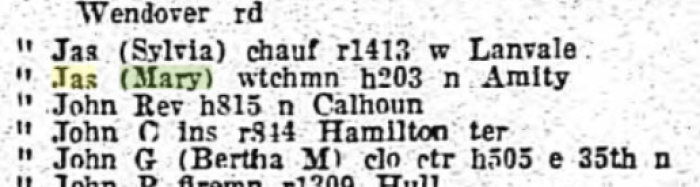
1926 Directory
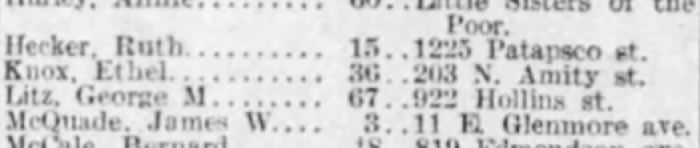
Notice of Ethel Knox's Death, c. 1927
In the late 1920s or in early 1930, James Knox Jr. returned to his parents after almost a quarter of a decade with no contact. This event is mentioned in an article printed in 1930 by The Evening Sun, which mentions that with no warning, James Knox Jr. reappeared on the doorstep of his parents' home and knocked on the front door.
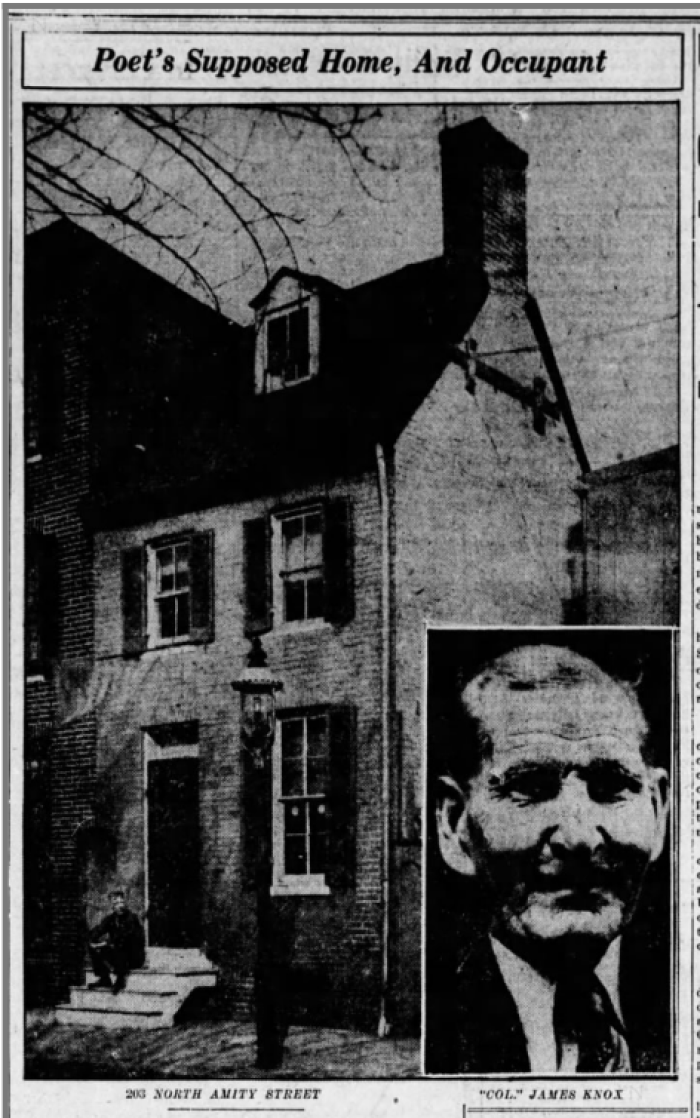
The Evening Sun, Mar. 18, 1930
This article also states that the Knox family argues that Poe was born at 203 N Amity St, a claim that is not supported by facts. Poe was born in Boston. However, at the time of the article, it seems that Poe's birthplace had not been authenticated yet, so some scholars did explore that possibility.
The Knoxes still lived at 203 N Amity St. as of 1930, when the census lists James (who still worked as a watchman) and Mary Knox as the residents. James Knox Jr. had also been listed, and he was unemployed at this time.
What happened to the Knox family after 1930 is unknown. An article from 1938 states that the building is at risk of being demolished, with no mention of the Knox family. We do not know if family members died or if the Knox family simply moved away. In any case, by the late 1930s, the house was at risk of being demolished along with the rest of the houses in the area.
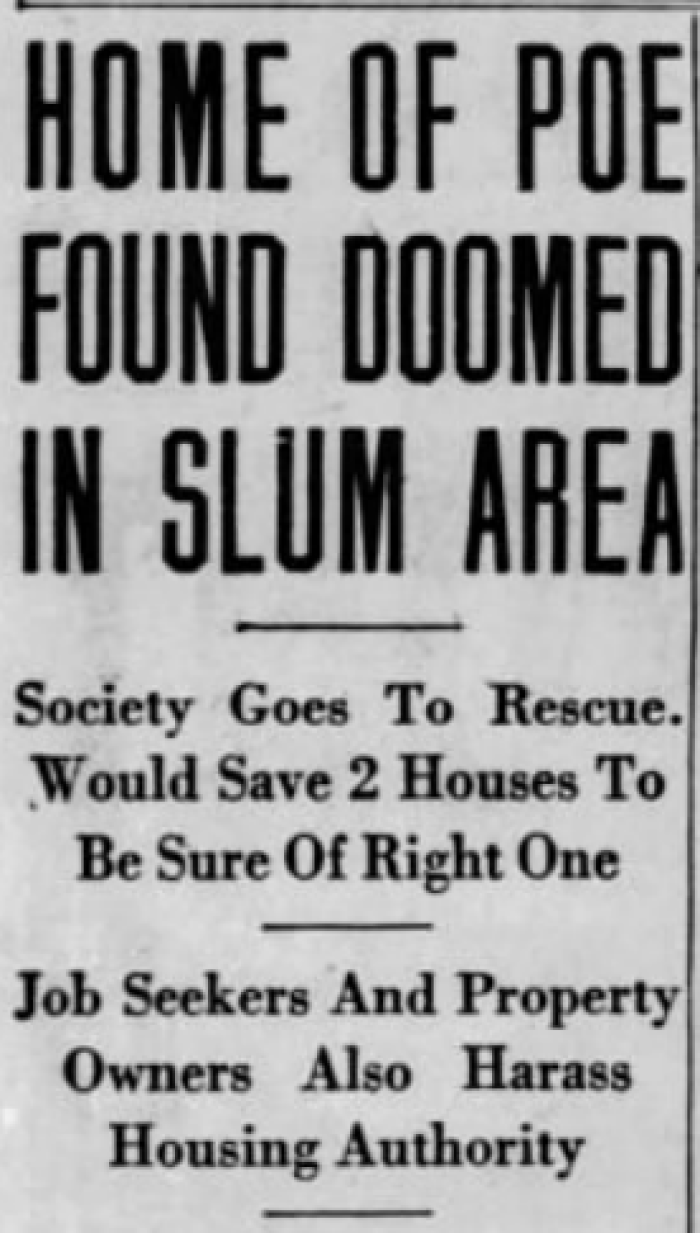
The Baltimore Sun, June 5, 1938
In the early 1940s, the house was owned by the city, but by 1947, the house was converted into a shrine to the author by The Poe Society, a group of Poe enthusiasts. The Poe Society advocated for the house when it was slated for demolition and succeeded in saving it. Renting it for $5 annually (or $72.92 as of Sept. 2025), The Poe Society sought to create a place where Poe's history would be preserved, and in 1949, after some renovations, the house was officially opened to the public.
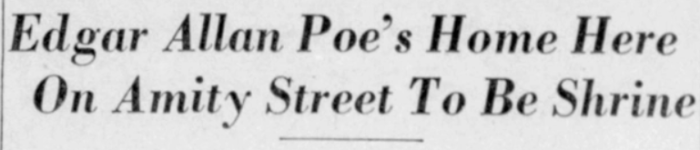
The Baltimore Sun, Jul. 24, 1947
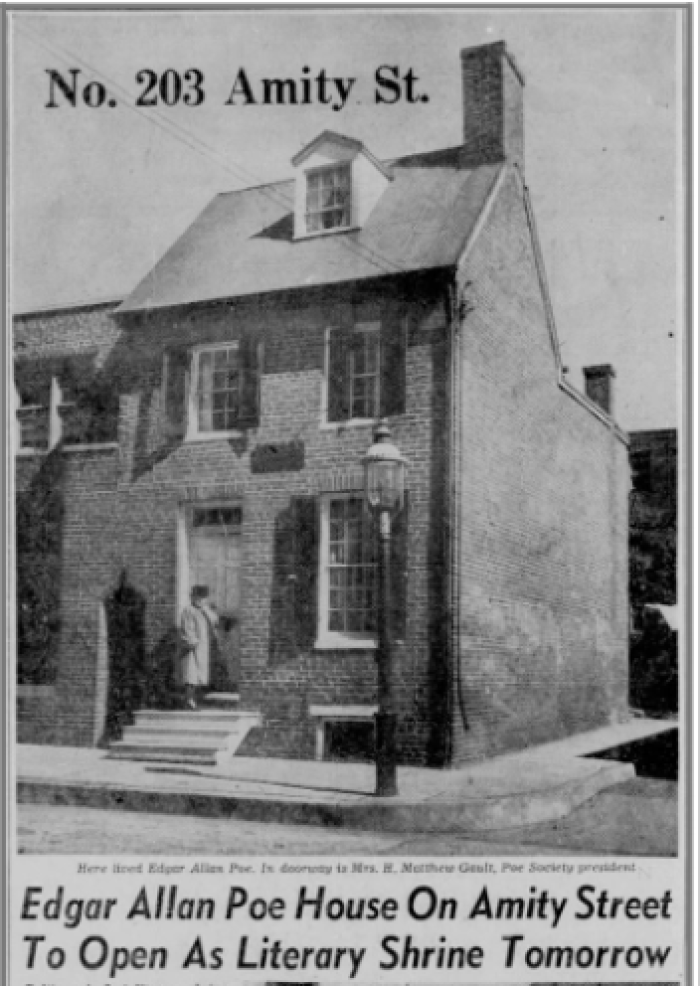
The Evening Sun, Oct. 1, 1949
In 1950, it operated as a museum, so there are no records in the census. However, in October of that year, an article was published by The Baltimore Sun about the renovations to the house and what the inside looked like.
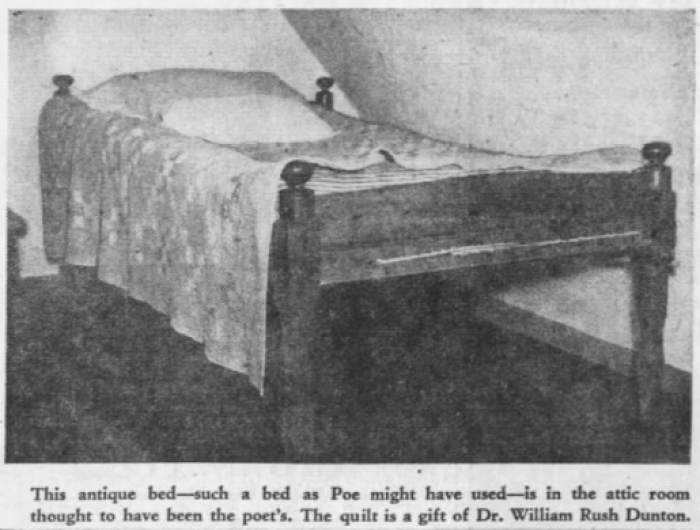
The Baltimore Sun, Oct. 8, 1950
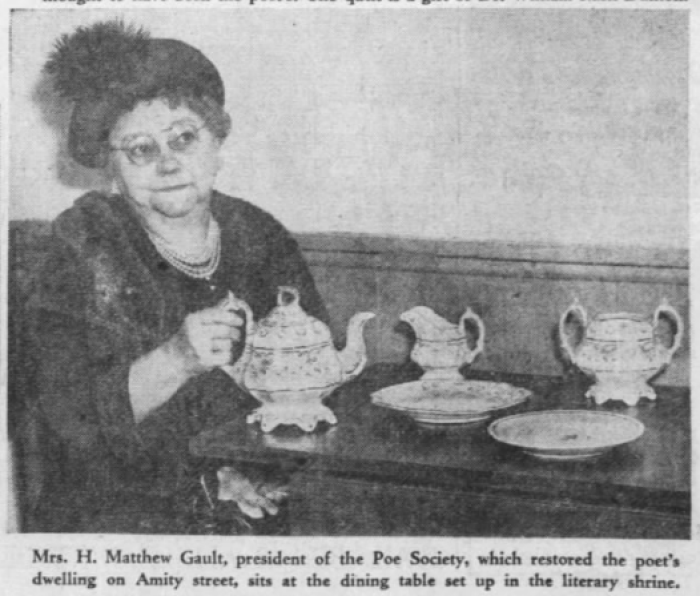
The Baltimore Sun, Oct. 8, 1950
The house continued to be used as a museum throughout the latter half of the 20th century. In 1995, however, concerns were raised about the security of the neighborhood in which the house rested because a hold-up had occurred not far from the home. Nothing seems to have been done to placate those concerns, but nothing similar to this event seemed to happen in the years since.
The Baltimore Sun, Nov. 7, 1997
Next on our timeline is a family reunion in 2005. Poe did not have any children, but he did have relatives. Luke Harvey Poe Jr., a distant relative of Poe, was given a personal tour of the home and discussed Poe with the curator, Jeff Jerome.
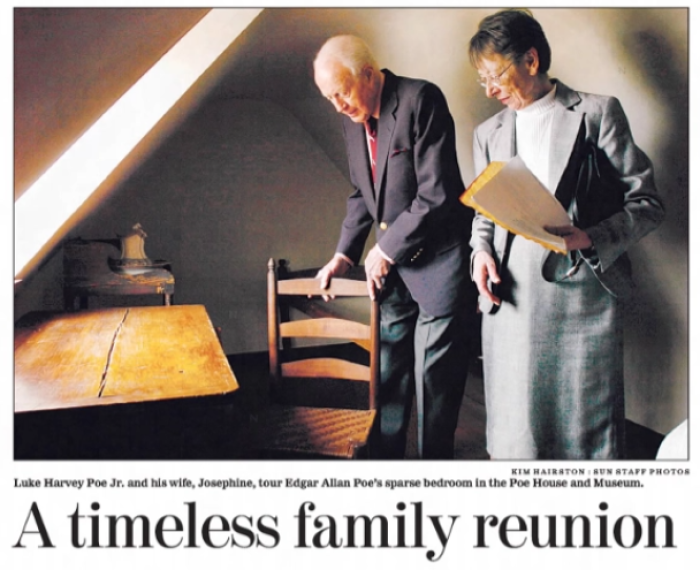
The Baltimore Sun, Jan. 16, 2005
Not much happens after that, but in 2011, it did not look good for the Poe House, as budget cuts threatened to close the house doors. With donations and contributions, as well as a change to the management of the financials, there was a chance to keep it going.

The Baltimore Sun, Feb. 5, 2011
In the last few years, the house has been proclaimed as a "Literary Landmark," the first of its kind in Maryland. The home is still being operated as a landmark under the name The Edgar Allan Poe House and Museum, and tours are available for those curious and inquisitive.

The Baltimore Sun, Dec. 8, 2019
If you are curious about Poe, as well as the documents mentioned here, please visit our 203 N Amity St. timeline.
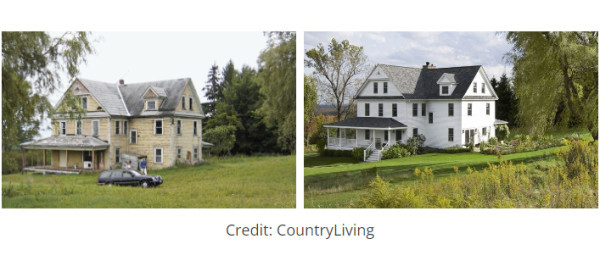
Busting Historic Property Remodel Myths
Have you ever come across an unforgettable run-down historic property you wanted to restore?
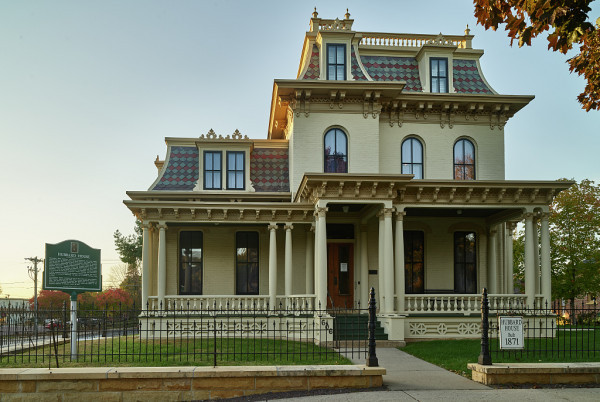
How to register your home on the National Register of Historic Places
Exploring the National Register of Historic Properties, a comprehensive list of significant sites, buildings, structures, and districts throughout the United States that possess historical, architectural, or cultural significance.
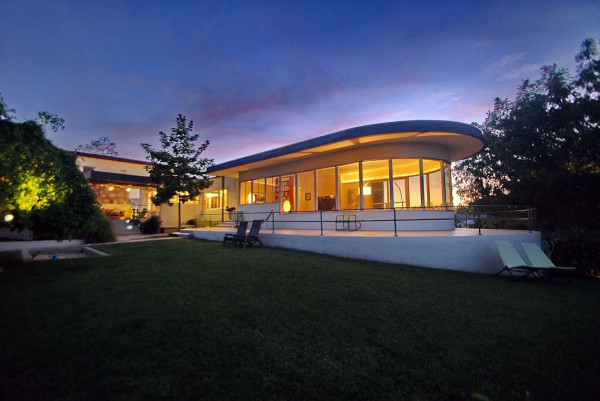
Architectural Innovator: Unveiling the Genius of Raphael Soriano
Step into the world of architectural brilliance as we delve into the legacy of Raphael Soriano, a visionary who redefined the landscape of design.
Beyond Thrilling Experience of Buying a Historic Property
You might have always fancied living in an 18th-century property with Georgian architecture, or a 19th-century exotic mansion.
