Not the Up House—But Even Better: Edith Macefield Said No to $1 Million, So They Built a Mall Around Her
You may have heard about the one-bedroom house in Seattle that blocked a mall.
August 21, 2025
The $1 Million Refusal
In 2006, Edith was 84 years old, living in a modest 1,050-square-foot cottage at 1438 NW 46th Street. Developers were scooping up every parcel of land in sight, preparing to build what would become the five-story Ballard Blocks mall. They knocked on Edith’s door with an offer: $750,000.
For context, that was about six times what her house was worth.
She said no.
So they came back with more. $1 million. Plus relocation support. Plus help hiring a caregiver.
Edith still said no.
Why? Because this wasn’t just a house to her. It was where she’d lived since 1952. It was where she had cared for her mother, mourned the loss of her only son at just 13, and outlived four husbands. Every wall held a memory, and Edith wasn’t about to trade that for a condo or a retirement facility.
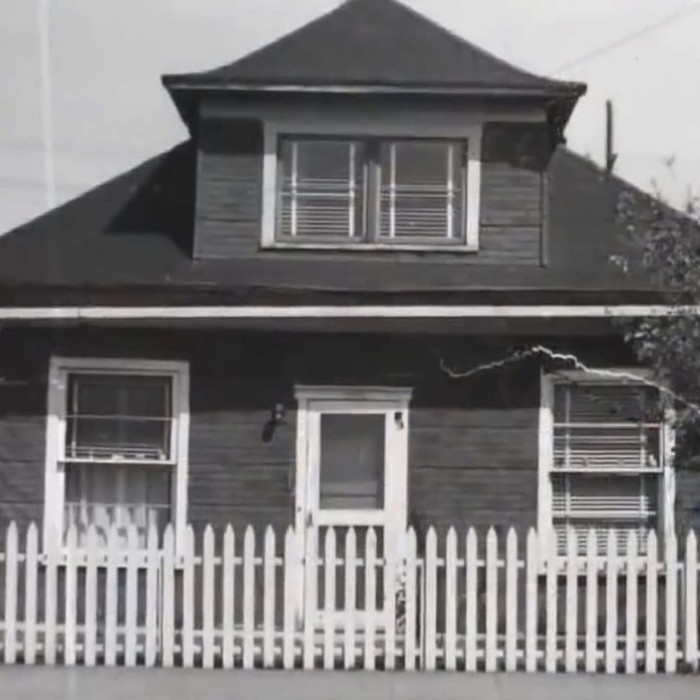
The Life Behind the Legend
Edith wasn’t just private—she was mysterious. She rarely talked about her personal life, but when she did, the stories were jaw-dropping.
She claimed she had worked undercover in Nazi Germany during World War II, helping children escape concentration camps. She even said she’d met Hitler. Later, she told people she married famed Austrian opera singer Richard Tauber.
Whether every detail was true or not almost didn’t matter—her life clearly had more layers than most people ever guessed.
So while the developers bulldozed everything else on the block, Edith’s little house held firm.
Building Around Edith
Eventually, the developers gave up trying to buy her out. With deadlines looming, they had no choice but to build the shopping complex around her home.
Picture this: massive cranes, concrete pouring, steel beams rising on all sides—while in the middle sat Edith’s tiny cottage with her lace curtains and flowerpots.
It was like a David-and-Goliath moment in real estate. Locals drove by just to see it. Newspapers ran with headlines about the stubborn woman who refused a million dollars. Some people thought she was crazy. Others thought she was a hero.
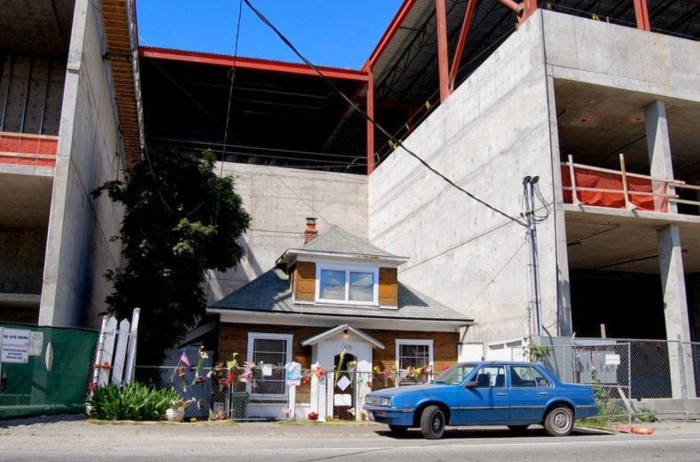
An Unlikely Friendship
One of the most touching twists in the story is Edith’s friendship with Barry Martin, the construction superintendent overseeing the mall project. What started as a tense relationship (“How on earth do we build a mall around this house?”) turned into something much deeper.
Barry began checking in on Edith, running errands, even taking her to doctor’s appointments. Over time, he became her closest friend and caretaker. When Edith passed away in 2008, she shocked everyone by leaving the house to Barry in her will.
What Happened After
Barry eventually sold the home to a local real estate investor who promised to preserve it as a kind of landmark. But turning Edith’s house into something sustainable proved tricky.
Zoning laws, sky-high renovation costs, and eventual foreclosure got in the way. At different times, people floated ideas: turning it into a pie shop, a public art installation, even an office. Nothing stuck. At one point, the house was literally listed for sale and lease—wedged in between two giant gray walls.
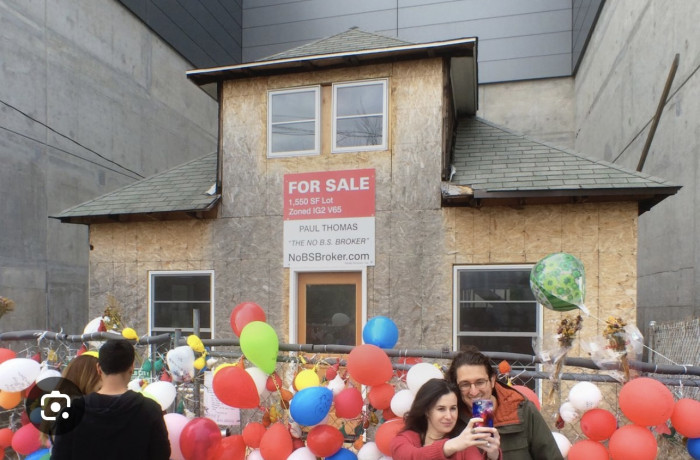
Then in 2009, Disney showed up with balloons. As part of promoting the movie Up, they tied a bunch to Edith’s roof, leaning into the nickname the press had already given it: Seattle’s “real-life Up house.”
The funny part? Up wasn’t based on Edith’s story at all—the script had been written years earlier. But the comparison stuck. And honestly, it made sense. Both were about one little house refusing to move in the face of a changing world.
The Symbol It Became
Today, Edith’s house still stands. Empty. Weathered. Boxed in by concrete walls that make it look even smaller than it is. But it hasn’t been forgotten.
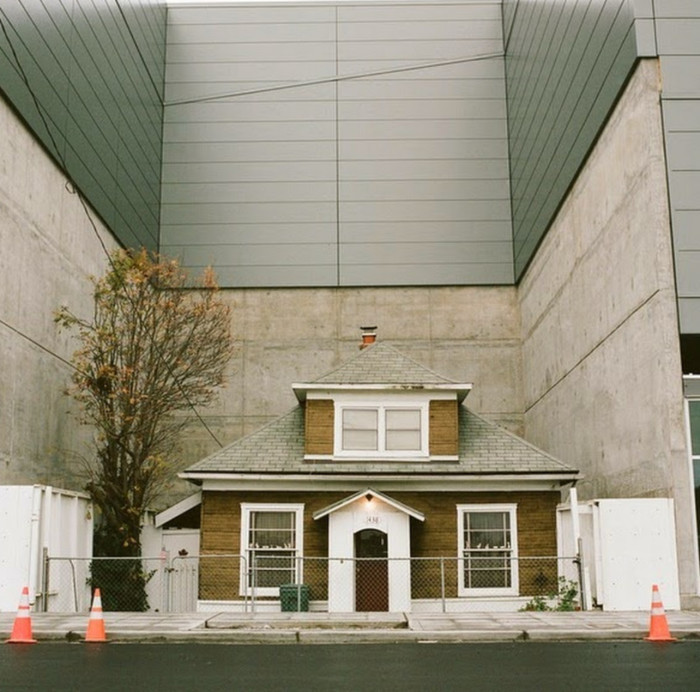
To some, it’s a sad sight—just an old house that should’ve been torn down years ago. But to many others, it’s something much bigger: a symbol of resilience, memory, and the refusal to be pushed aside.
Because at the end of the day, Edith’s stand wasn’t really about real estate. It was about dignity. It was about holding on to the place where her life unfolded—even when the whole city seemed to be moving on without her.
And that’s why Edith Macefield’s house is remembered not as just a quirky footnote in Seattle’s history, but as one of the boldest acts of defiance you’ll ever hear about.
Closing thought; Edith’s story proves that sometimes the smallest homes tell the biggest stories.

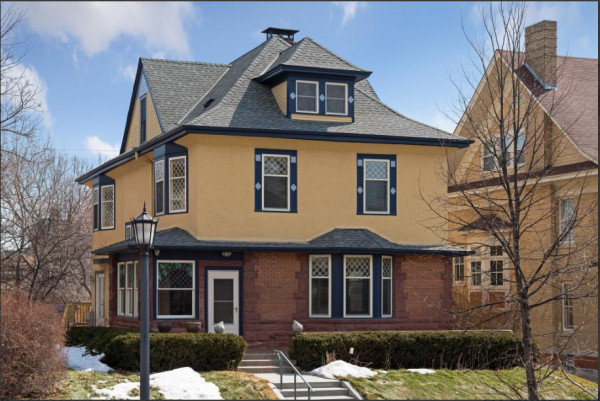
The Marrian Moyer House: A Monument to Past Lives and Architectural Creativity
Join us for a tour of our Marrian Moyer House, a place where the past is still visible in the stained-glass windows and the exquisite woodwork. Learn about the occupants of this home and how they lived in this grand example of early 20th century architecture.
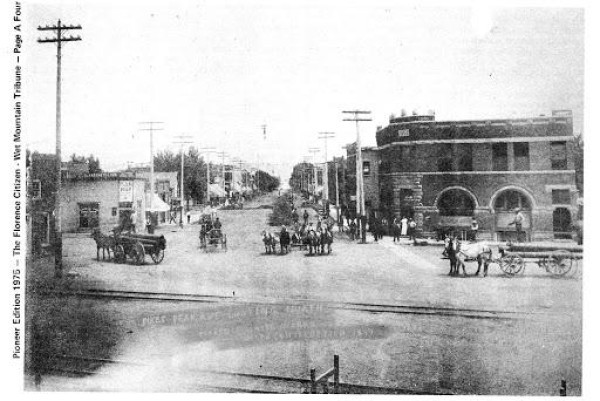
History of Florence Colorado
Florence, Colorado boasts a fascinating and vibrant history that has shaped the town into what it is today.

Racial covenants: Revealing the impact of racial covenants on your home's history
Tracing the lasting impact of racial covenants on communities and homes.
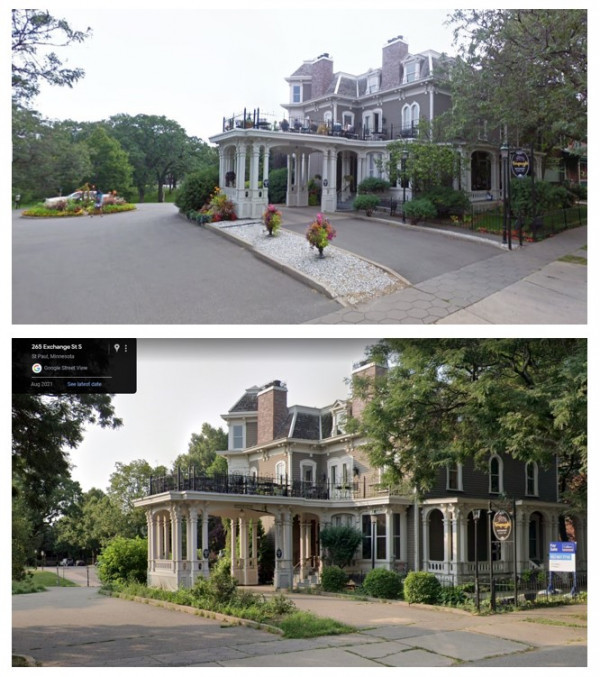
How to find my home’s history? A quick how-to guide to travel back in time with Google Street View
Time traveling with Google Maps is simple, here's how to do it.
